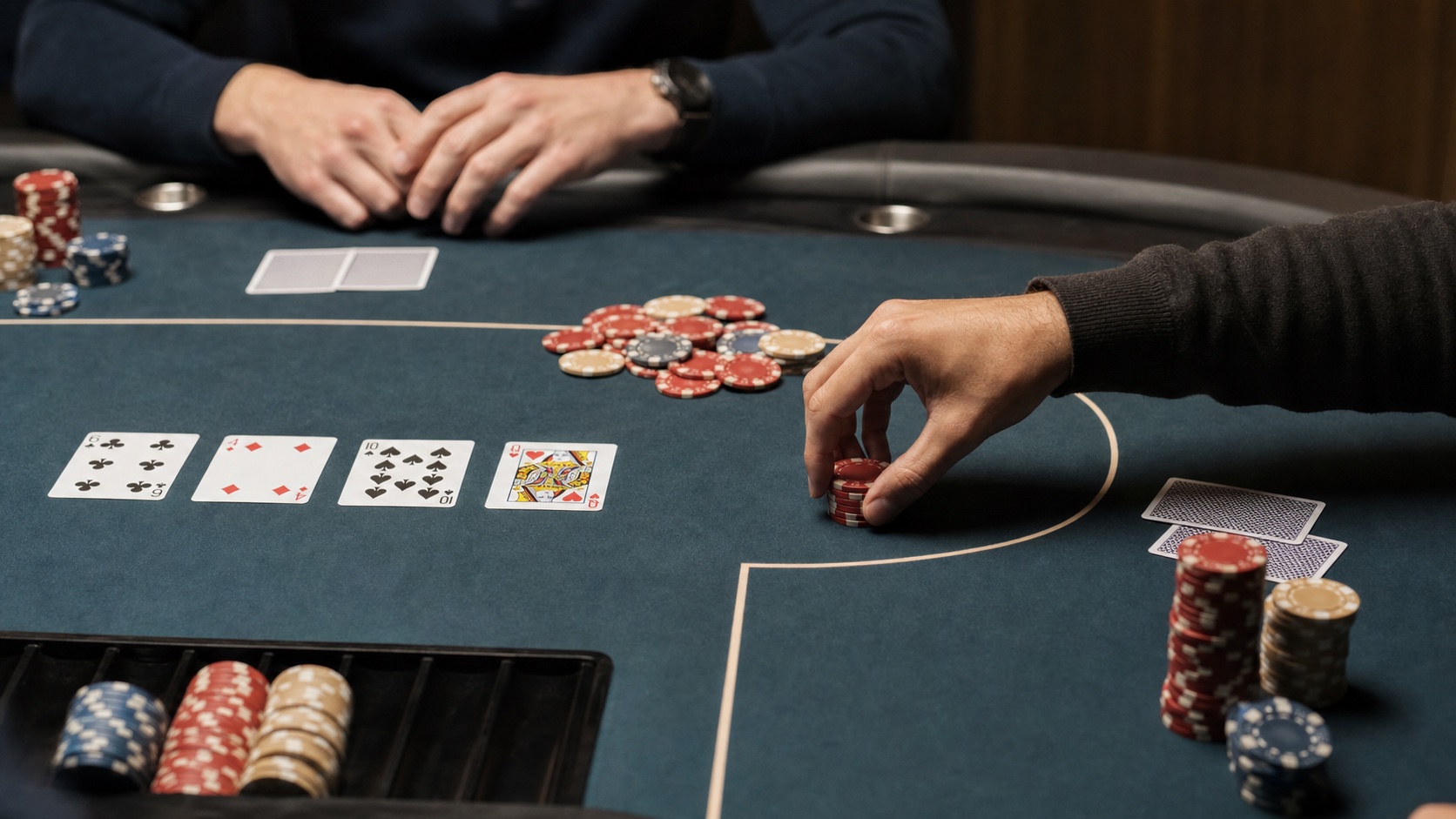
Bet probe is the bet made out of position on the turn after the pre-flop aggressor checked back on the flop. The classic sequence is: button opens, big blind calls, both players check the flop and the big blind bets when the turn arrives.
The aggressor's check removes part of the hands that would bet flop, but it does not automatically make your range weak. A good probe considers texture, positions, pre-flop sizings, turn card and plan for the river.
The goal is not to "steal because he has shown weakness". It is to take advantage of a real change in the distribution of the ranges and bet with value, protection or consistent bluffs.
Original cover image created for the GTO Vyve Poker.
Probe bet, donk bet and delayed c-bet
The names help to reconstruct the action:
- donk bet: the defender bets on the flop before the pre-flop aggressor can act;
- probe bet: the aggressor checks back on the flop and the defender bets the turn;
- delayed c-bet: the aggressor checks on the flop and bets when he receives a new check on the turn.
The three lines can exist in the same tree, but they represent different decisions. See donk bet no poker to understand when to lead already on the flop.
What the check on the flop informs
When the aggressor does not bet c-bet, some strong hands continue in the range. He can control the pot, protect checks, induce bluffs or consider the bad board to bet with high frequency.
At the same time, several hands of value and natural bluffs would bet the flop. The check can increase the proportion of:
- medium pairs with showdown value;
- overcards without strong backdoors;
- top pairs who prefer control;
- occasional traps;
- hands that would give up under pressure in bad turns.
Therefore, "checked, it's weak" is an exaggerated reading. The correct conclusion is: the range has changed and needs to be re-evaluated.
Textures that favor probe
The board texture determines which hands the defender has and which turn cards change the advantage.
Low flop that passes in check
Button opens, big blind calls and the flop comes 8♣ 5♦ 3♠. The aggressor checks. The big blind has pairs, two pairs, sets and connectors at a relevant frequency. Turns like 6, 7 or cards that create draws can strengthen your concentration of value and semi-bluffs.
Turn that favors the defender's range
In K♣ 7♦ 4♠, the button check preserves some kings, but a low card connected on the turn can improve pairs, two pairs and big blind draws. The probe now represents real hands, not just an attempt to steal.
Paired board
Paired low boards can favor the defender for the number of trips. However, the attacker can also give check with overpairs and top pairs. The probe needs to choose size and frequency compatible with this dispute.
Turn up after a low flop
An overcard like ace or king can benefit the pre-flop aggressor more. Automatically betting because there was a check on the flop ignores that the new card puts strong broadways and top pairs back in the rival range.
Why bet: value, protection and bluffing
Separate the range by function.
Value
Strong hands want to receive calls from peers, draws and bluff-catchers. Two pairs, sets, straights and some top pairs can bet according to positions and texture.
Ask which hand pays worse. If the answer is "none", the hand may prefer to check, even if it is ahead often.
Protection
A vulnerable hand can charge equity from overcards and draws. Protection does not mean eliminating everything: the bet must be paid for worse hands or generate relevant folds without isolating you only against the top.
Fake or semi-fake
Draws with equity and good rivers to continue are natural candidates. Hands without showdown value can bet when they block calls and leave folds available.
Avoid selecting bluffs just because "you can't win in the showdown". Some combinations do not have equity, blockers or enough river plan.
How to choose the sizing
Small and medium probes appear frequently because they attack a wide range of the range that gave check. Larger sizes require polarization and clearer advantage.
25% to 40% of the pot
A small bet can extract fine value, deny equity to overcards and pressure hands that cannot withstand two streets. It allows you to bet a larger part of the range, but offers a good price for calls.
50% to 75% of the pot
Medium sizes charge draws and increase pressure on partners. The range needs to withstand calls and raises more robustly.
Overbet
Probe above the pot exists in specific runouts, usually when the turn delivers strong nuts advantage to the defender and the aggressor is blocked. Before using, review the principles of overbet in poker.
Don't choose the size by appearance. List the high cards, the expected calls and the bluffs before moving the chips.
Practical example of probe in turn
Cash game, 100 effective blinds. The cutoff opens to 2.5 blinds, the big blind calls. Flop 9♠ 6♦ 2♣, pot of approximately 5.5 blinds. Both check. Turn 7♠.
The big blind wins:
- straights with
85 and T8 when defended;
- two pairs like
97, 76 and some 96;
- pairs with draws;
- flush draws and straight draws;
- strong hands that checked the flop.
The cutoff still has overpairs, 9x, traps and draws. The probe can exist, but you should not use all hands. Strong and semi-bluffs make sense; weak pairs without a plan can check.
If the river is a sword, which flushes do you represent? If you fold the 9, who wins more trips and full houses? If an ace comes up, who has more Ax? Answering before betting avoids arriving at the river without direction.
The plan for the river starts at the turn
Before the test, classify rivers:
- rivers of value: allow new bet with strong hands;
- bluff rivers: favor your range and pressure bluff-catchers;
- rivers of showdown: recommend check with medium hands;
- dangerous rivers: improve the rival range or complete draws that you do not represent;
- rivers for check-raise: rare and dependent on reading and range building.
A bet without a plan tends to create two mistakes: giving up on good cards or continuing on bad cards just because "you have already bet". Chips placed on the turn do not require a new bet.
How to face the probe
If you are the aggressor who checked on the flop, don't just defend the current hand. Consider how your check range was built.
Calls
Top pairs, overpairs, pairs with draws and some hands that block value can continue. Pot odds define the minimum equity, but equity realization and possibility of new bet on the river also matter.
Raises
Raises need strong value and consistent bluffs. Increasing only to "take the initiative" creates an artificial range. Flop traps and turns that favor your range can sustain the line.
Folds
Overcards without backdoors, weak pairs and hands blocked by larger sizings can simply fold. The check on the flop does not create an obligation to defend the entire range on the turn.
Common errors with probe bet
Bet on every turn after check
Adversaries notice the excessive frequency and start checking with strong hands or increasing probes. Preserve checks with value and medium hands.
Confuse capped range with empty range
The attacker can have top pair, overpair and traps. "Covered" means less nuts, not absence of strong hands.
Always use the same size
Boards and objectives change. A 33% bet and a 75% bet ask for different ranges.
Ignore the pre-flop position
UTG against big blind is not the same as button against big blind. Stronger initial ranges preserve more overpairs and top pairs after the check.
Only evaluate the result
Receiving a fold does not prove that the probe was good. Being paid by a trap does not prove that it was bad. Review ranges, sizing and runout.
Probe in tournaments and ICM
Short stacks reduce space to bet turn and fold river. A 60% probe can compromise a large part of the stack. In a bubble or final table, the cost of elimination changes marginal decisions.
Consider:
- effective stack in blinds;
- pot/stack ratio after the bet;
- risk of raise all-in;
- monetary value of the chips under ICM;
- difference between covering and being covered by the rival.
Read ICM explained before transferring cash frequencies directly to MTT.
Review checklist
When marking a probe in the replay, answer:
- who was the pre-flop aggressor;
- why the flop passed in check;
- which range did the turn favor;
- your bet was value, protection or bluff;
- which worse hands paid;
- which better hands folded;
- which rivers would continue;
- how the stack and ICM altered the line.
Also compare the hands you checked. A good range of checks prevents your probe from becoming predictable.
FAQ
Probe bet only exists in the turn?
The most common use of the term is betting on the turn by the defender after the pre-flop aggressor gave check back on the flop. Some people use the term more broadly, but recording the sequence avoids ambiguity.
Is probe bet always a bluff?
No. The range must include value, protection and bluffs. Betting only weak hands leaves the line vulnerable to calls and raises.
What sizing to use on the probe?
It depends on the texture, advantage of nuts, stacks and target. Small bets attack a wide area; large sizes ask for more polarized ranges.
Should I always bet whenever the aggressor gives a check?
No. He preserves strong hands and can use traps. Evaluate the turn's hand and keep checks protected.
How to study probe bet without solver?
Separate hands by position, texture and turn card. Review pot odds, value, bluffs and river plan. A replay tool organizes patterns, but does not replace a validated solution for the spot.
The GTO Vyve organizes its hand histories to locate probes, sizings and recurring responses. Use the data as support for the study, with enough sample and without treating a heuristic suggestion as an exact solution.
+18. Poker involves risk and variance. Play responsibly and never chase losses.