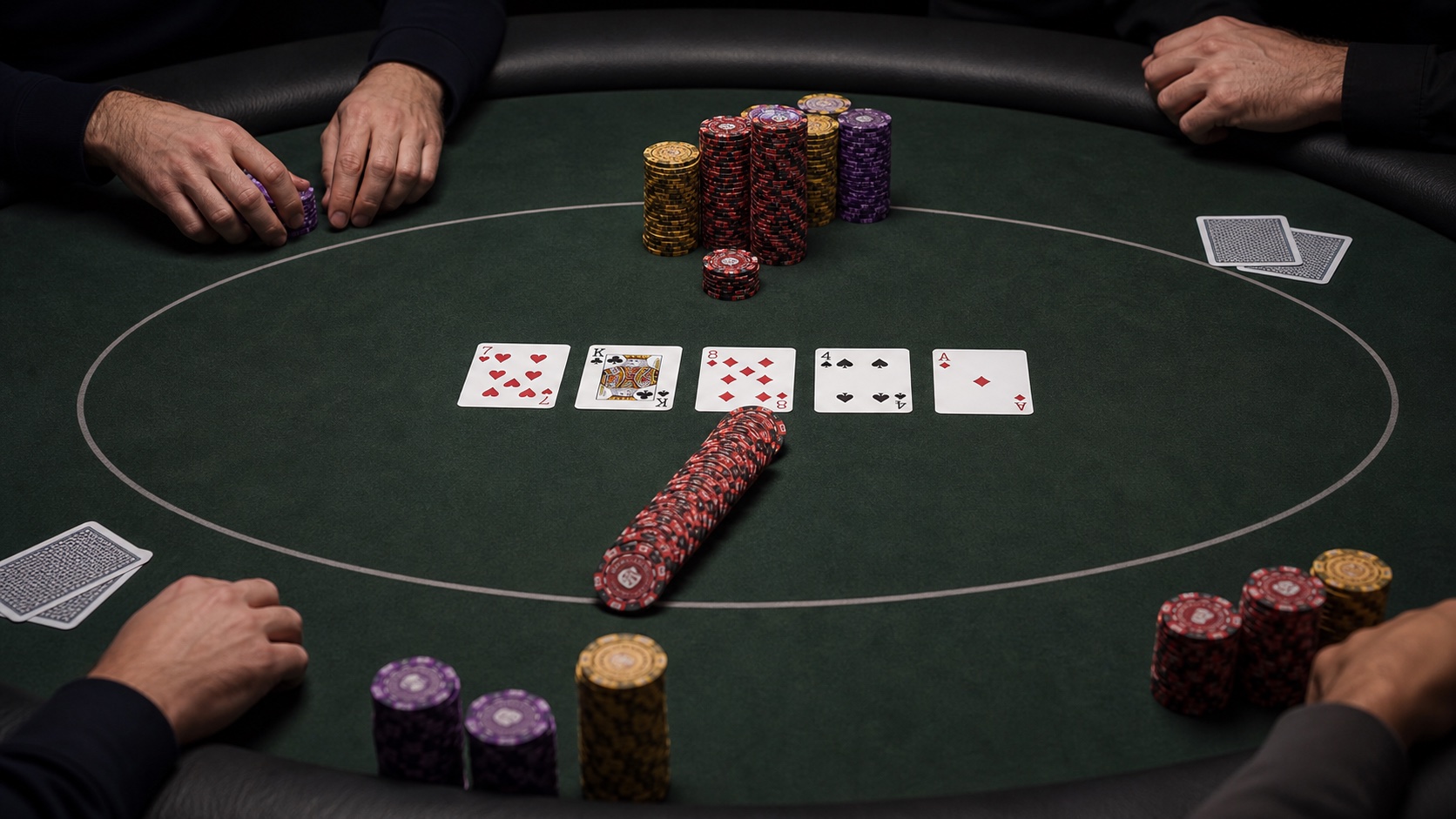
Overbet is a bet larger than the pot. If there are 100 chips in the center and you bet 125, 150, or 200, you are using an overbet. The size catches attention, but it is not a strong play by definition: a coherent strategy combines very strong value hands with bluffs that have good blockers.
The central idea is to pressure a part of the opponent's range that arrives at the street with many medium hands and few combinations capable of facing big bets. This usually happens on the turn or river, when the texture and the sequence of actions clearly favor the top of your range.
Overbet should not be an automatic button to "represent strength". Before increasing the size, you need to understand who has an advantage of nuts, which hands call and which bluffs make sense.
Original cover image created for the GTO Vyve Poker.
What changes when the bet goes over the pot
A big bet offers worse pot odds to the defender, but also risks more chips. If the pot is 100 and you bet 150, the opponent calls 150 to compete for a final pot of 400. He needs to win 37.5% of the time for the call to tie before considering rake or tournament effects.
Some reference points:
| Bet |
Approximate minimum equity to call |
| 50% of the pot |
25% |
| 75% of the pot |
30% |
| 100% of the pot |
33.3% |
| 150% of the pot |
37.5% |
| 200% of the pot |
40% |
The jump seems small in percentage, but it changes a lot which bluff-catchers continue. A hand that pays a half pot bet may not have enough equity against a polarized range of 150%.
For those who bet, the risk also increases. A 150 bet on a pot of 100 needs to generate folds more times than a 50 bet. That's why choosing random combinations destroys the logic of the line.
Polarized range: strong value or bluff
Overbet ranges tend to be polarized. On one end are hands that want to extract a lot of value; on the other, bluffs. Average hands often prefer check or a smaller sizing, because they do not receive enough calls from worse hands and cannot make better hands fold.
Imagine that you arrive at the river with nuts, seconds nuts, top pair, medium pairs and lost draws. An overbet can use some of the nuts for value and some lost draws for bluffing. Top pair may prefer to check, depending on the board and the rival range.
This separation is not absolute. There are spots where hands outside the top bet big for range advantage, but the question remains useful: which worse hand calls my value bet and which hand folds better for my bluff?
If you can't answer, the size was probably chosen by emotion, not by strategy.
The texture decides who can press
The starting point is the board texture. Overbet appears more naturally when a card changes the distribution of the nuts in favor of the bettor.
Turn that favors the aggressor
You open with the button, the big blind calls and the flop comes A♠ 7♦ 2♣. After a small c-bet and call, the turn is K♥. The aggressor has more strong combinations of AK, AA, KK and good aces. The defender arrives with many worse aces and pairs facing an uncomfortable decision.
This does not mean betting big with the entire range. It means that there is a structural base to build value and bluffs.
River who completes his strong range
In connected boards, a card that completes straights present in your range can favor overbet. The analysis must consider previous actions: if your strong combinations would bet flop and turn in this way, the story is consistent. If the nuts would have chosen another line, the overbet loses credibility.
Neutral letter against capped range
Sometimes the river is a blank, a card that changes the nuts little. Still, the opponent may be blindfolded because his stronger hands would have increased earlier. If you have preserved the top of the range, asymmetry allows pressure.
"Caped" does not mean weak. It just means that the range contains few combinations of the absolute top.
Blockers and unblockers in bluffs
Blocker is a card from your hand that reduces possible combinations in the opponent's range. In a river overbet, good bluffs often block strong calls and leave folds available.
Example: the board ends with three cards of the same suit. Having the ace of that suit can block the opponent's nut flush, even when your hand does not form a flush. This combination can be a better candidate for bluffing than another hand with the same showdown value.
The other side is the unblocker. You don't want to block the hands you intend to fold. If the opponent comes with many pairs of medium cards containing a certain card, having that card reduces the available folds.
Use this order:
- list the amount you bet a lot;
- identify the strongest calls of the rival;
- choose spoofs that block part of these calls;
- avoid blocking the part that should fold;
- confirm that the line arrived at the river with these combinations.
Blockers do not turn any hand into a bluff. They are used to order candidates within a range that already has a strategic reason to bet.
How to choose the size
There is no "the" sizing of overbet. 110%, 125%, 150% and 200% create different pressures. The effective stack limits the choice.
Before betting, project the pot:
- how much is left in the stack if there is a call;
- which worse hands continue against 125% and against 175%;
- if the value prefers to extract a street or prepare all-in;
- if the bluff needs to generate folds that a smaller size does not generate;
- if the ratio between value and bluff remains defensible.
In short stacks, an apparently big bet can be just all-in. In deep stacks, successive overbets require planning from the flop. Also see second barrel to organize turn and river as a sequence, not as isolated decisions.
Spots where overbet usually worsens the decision
Avoid using large size without an identifiable advantage.
Opponent's range still contains many nuts
If the rival can reach the same top of range at high frequency, he has natural raises and calls. You risk more without pressing a really cut-off area.
Your hand has average showdown value
Automatically turning medium pairs into bluff can make worse hands fold and better hands call. Check frequently preserves value.
Board changes against you
A card that completes more draws from the defender than the aggressor can transfer the nuts advantage. Betting big just because you c-betted before ignores the new texture.
Opponent calls too much and you don't adjust
Against someone who makes excessive calls, reduce bluffing and expand value carefully. An exploitative strategy does not require maintaining the same theoretical frequency when the trend is well supported by sample.
Tournament with ICM pressure
In the bubble and final table, losing chips can cost more monetary value than winning the same number adds. This changes calls, bluffs and disposition to create giant pots. ICM in poker should enter the analysis before sizing.
Example of construction on the river
Consider a pot of 40 blinds at the river. You have 70 blinds behind and you evaluate betting 60.
First, list six value combinations that naturally come up by the line. Then look for bluffs between lost draws. Don't start by choosing "ten bluffs because I want to pressure". The amount should talk to the sizing and to the number of value hands.
Then, compare the candidates:
- bluff Blocks the nut flush but does not block top pair;
- bluff B blocks pairs that should fold;
- bluff C still wins from lost draws and may prefer check;
- bluff D does not represent the line because he would have given up on the turn.
The A bluff tends to be the better candidate. The exercise does not deliver a universal frequency, but improves the quality of selection.
How to review overbets in replay
Mark all hands in which you bet more than 100% of the pot and answer:
- which part of the rival range was blocked;
- who had the most nuts on the street;
- which valuable hands would use the same size;
- which strong call your bluff blocked;
- which folds did he leave available;
- what would be the strategic result of smaller check or sizing;
- if the decision changed by stack, ICM or observed trend.
Don't judge by the isolated hand that passed. A bad bluff can get folded; a good value bet can lose. The replay serves to recover the decision tree and separate the process from the result.
FAQ
Is Overbet always a polarized bet?
In practice, she usually concentrates strong value and bluffs, especially on the river. There are exceptions depending on ranges and texture, so polarization is a principle of study, not a mechanical rule.
What is the best overbet: 125% or 150%?
It depends on the actual stack, the nuts advantage, the hands that call and the ratio of value and bluff. Compare what changes in the opponent's range; don't just choose a favorite number.
Can I use overbet in micro stakes?
Yes, but adjust to the population and the opponent. Against excessive calls, prioritize value and reduce bluffing. Without reliable sampling, avoid strong conclusions about a single session.
Does Overbet work better on the turn or the river?
Both streets allow overbet. On the turn, the size can prepare a river all-in. On the river, ranges are more defined and blockers gain importance.
Does an overbet guarantee more folds?
No. It increases pressure and risk, but the opponent may have a strong range or tendency to call. No sizing guarantees a result.
The GTO Vyve helps organize hand histories and replays so you can find sizing patterns and review decisions with context. The analysis supports study; it does not replace validated ranges for each spot nor promises financial results.
+18. Poker involves risk and variance. Play responsibly and never chase losses.