Donk bet is the bet made out of position by someone who was not the aggressor in the previous street, before the aggressor has the opportunity to bet. The classic example is the big blind calling a pre-flop raise and leading on the flop against the raiser.
The name carries an old connotation of weak play, but the action is not automatically bad. Solvers find leads in certain textures, sizings and configurations. At the same time, many players use donk bet without clear range, transforming the line into exploitable information.
The goal is not to start leading any flop. It is to understand when the texture changes the advantage of nuts and when check continues to be the main strategy.
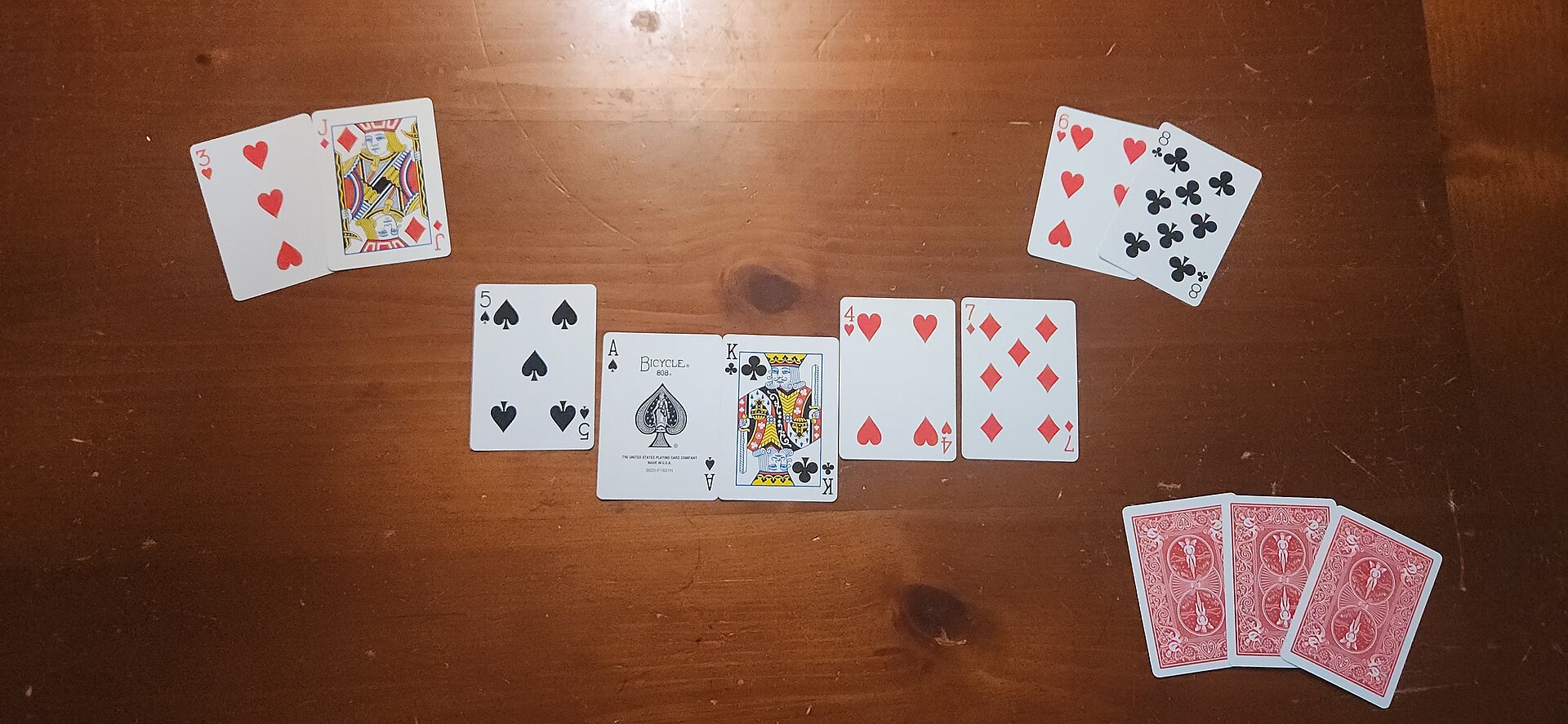
Cover image: Tarlby on Wikimedia Commons, CC BY-SA 4.0 license.
What characterizes a donk bet
Typical sequence:
- cutoff opens;
- big blind paid;
- flop is distributed;
- big blind bet before the cutoff.
The big blind was not the pre-flop aggressor, so the bet is a lead or donk bet.
If both checked the flop and the big blind bets the turn, the label depends on the action line. Many players call it delayed lead. The principle is the same: whoever had the prior initiative did not bet on the current street before the out-of-position action.
Range advantage and nuts advantage
The pre-flop aggressor usually has strong hands such as high pairs and broadways more frequently. This creates range advantage in many high and dry flops.
The big blind defender, however, has combinations that the raiser may not have or has less:
- two pairs with low cards;
- straights on connected boards;
- trips in paired low cards;
- some suited connectors and gappers.
When the board favors these combinations too much, the defender can have an advantage of nuts, that is, more hands at the absolute top of the range. This distribution can sustain leads.
See Board texture in poker to classify dry, connected and monotone boards before deciding.
Boards that can generate leads
There is no universal list, because positions, sizings and ranges change. Some patterns are useful for study.
Low and connected flops
Boards like 6♣ 5♦ 4♣ can reach the big blind's defense range with pairs, two pairs, sets, straights and strong draws. The raiser still has overpairs, but he doesn't always dominate the nuts.
Paired low flops
In 6♠ 6♦ 3♣, the big blind can defend more 6x than the raiser opens from initial positions. Small leads appear in some solutions.
Turns that change the advantage
Even after a check-call on the flop, a low card connected on the turn can increase the defender's nut concentration. Some spots allow lead on the turn.
These examples are study hypotheses. Exact frequency and size depend on the input ranges.
Boards where check dominates
High and dry flops usually favor the attacker.
Example: UTG opens, big blind calls, flop A♠ K♦ 4♣. UTG contains more AA, KK, AK, AQ and other strong aces. The big blind does not gain a clear advantage by leading.
Check preserves the entire range, allows response to c-bet and avoids building a lead with weak hands without value coverage.
What is a donk bet for?
A well-built strategy can:
- extract value from worse hands;
- charge equity for overcards and draws;
- perform equity with part of the range;
- press the weaker part of the opponent's range;
- distribute bets between leads and checks in specific textures.
"Discovering where I am" is not a technical objective. A bet must generate value, folds or realization of equity; information is a consequence.
How to set up the lead range
If you bet only medium-hand made hands, opponents can increase frequently. If you bet only monsters, your checks are unprotected. A coherent range needs to consider:
- strong value;
- semi-equity shares;
- relevant blockers;
- hands that prefer check-call;
- hands that protect the check range;
- response to raises.
In mixed strategy, the same hand can bet some times and check others. In practice, use simplification that you can execute without losing the logic.
Donk bet sizes
Small sizing
Bets of 20% to 33% of the pot can reach a large part of the opponent's range and allow wider frequency. They also offer good price, so they need a plan against calls and raises.
Medium sizing
Build a pot with value and press marginal hands. Requires more selective range.
Large sizing
It represents polarization and appears in specific settings. Using large only to "protect" a vulnerable hand usually creates an unbalanced range.
Do not copy the size without copying the ranges and the texture that justify it.
Example of lead by nuts advantage
Button opens 2.2 BB and big blind calls. Flop 7♥ 6♥ 4♣.
The big blind can have 85, 53, 76, 74, 64, 77, 66 and 44 in different frequencies. The button also has sets and suited connectors, but its range includes many broadways and overcards without connection.
A small lead can be built with part of the value and draws. However, positions, rake, open size and pre-flop strategy change the solution. The correct conclusion is "study this hand", not "always bet low flops".
Example of exploitable donk bet
Player bets on the big blind and leads half of the pot in K♣ 8♦ 2♠. When he receives a raise, he folds almost always.
If the line contains medium pairs and weak draws, but almost no strong Kx or set, the opponent can increase aggressively. The leak is not the "bet" button; it is the lack of hands capable of continuing.
When reviewing, count how many leading hands call, raise or fold against a raise.
How to respond to a donk bet
Don't treat all donk as weakness. Start with the size and texture.
Small against sizing
You get good pot odds and can continue wide, but you should select value and semi-bluff raises. Overcards with backdoors can call on some boards; hands without equity continue folds.
Large anti-sizing
The range tends to be more polarized. Keep with hands that support the size and raises that represent real value.
Against player's standard
If there is a reliable sample, adjust:
- frequent donk followed by fold: increase pressure with appropriate candidates;
- donk only with value: fold marginal hands;
- small donk with full range: defend and increase in a structured way;
- random line without repetition: avoid strong conclusions.
Exploit requires evidence. One hand does not define trend.
Donk bet in multiway pots
With more players, the probability of someone having a strong connection increases. Bluffs lose efficiency and continuation ranges become stronger.
Multiway leads should be more careful:
- more robust value;
- strong draws;
- less pure lies;
- attention to relative positions;
- sizings that consider several ranges.
A heads-up solution should not be transferred directly to the pot with three or four players.
Tournaments, stacks and ICM
Short stacks reduce space for multiple bets. A lead that compromises a large part of the stack needs to consider the plan against shove.
Near the bubble, ICM can leave raises and calls tighter. The texture remains important, but the monetary value of the chips changes incentives. Consult ICM in poker before applying a cash line at the final or satellite table.
Donk bet on the turn and river
A letter can change who owns more nuts.
Example: big blind gives check-call on A♣ 7♦ 5♦. Turn 4♣. The defender has more 86, 63, two pairs and pairs with draw; the aggressor still has strong aces. Some ranges can lead some hands.
In river, leads can look for value or bluff when the final hand completes combinations of the defender. The process is the same:
- rebuild ranges;
- identify change of nuts;
- choose value and bluffs;
- decide sizing;
- protect checks.
Common leaks
- Bet on "knowing where it is".
- Lead weak top pair and fold all raise.
- Use donk in every low flop.
- Copy solver frequency without copying ranges.
- Do not protect the check range.
- Ignore raiser position.
- Use heads-up solution in multiway.
- Judge the line only by the result.
- Do not plan turn and river.
How to review donk bets on GTO Vyve
Filter hands where you paid pre-flop out of position and bet before the aggressor. In the replay, note:
- effective positions and stacks;
- board texture;
- range and nuts advantage;
- lead's value hands;
- semi-fees;
- plan against raise;
- favorable and unfavorable turns.
Compare at least twenty occurrences. If all leads are medium pairs, the opponent can exploit. If you never lead boards that are very favorable to the defender, you may be leaving a strategic option aside.
The GTO Vyve organizes hand histories, replays, notes and patterns in clear language. Its heuristics do not replace an exact solution for all formats and do not guarantee profit.
FAQ about donk bet
Is Donk bet always a bad move?
No. There are theoretical leads in certain textures. The play is bad when it lacks consistent range, sizing and plane.
Should I increase all small dicks?
No. The price allows wide calls, but raises need adequate value, equity and blockers.
Which boards favor the big blind?
Low, connected or paired boards can favor your nuts advantage. The answer depends on the pre-flop positions and ranges.
Can I use donk bet multiway?
It can exist, but bluffs should be reduced and the value needs to be stronger because several ranges are still in hand.
How to know if my lead is unbalanced?
List valuable hands, bluffs, calls and folds against raise. If an action always reveals the same strength, the pattern is exploitable.
Conclusion
Donk bet is not an information button or automatic error. It appears when texture and ranges justify action out of position. Study nuts advantage, choose sizing and keep hands capable of responding to raises. If you can't explain the range, check is a safer simplification.
👉 Find donk bet patterns in the replay of GTO Vyve. +18 | Poker involves risk and variance. Play responsibly.