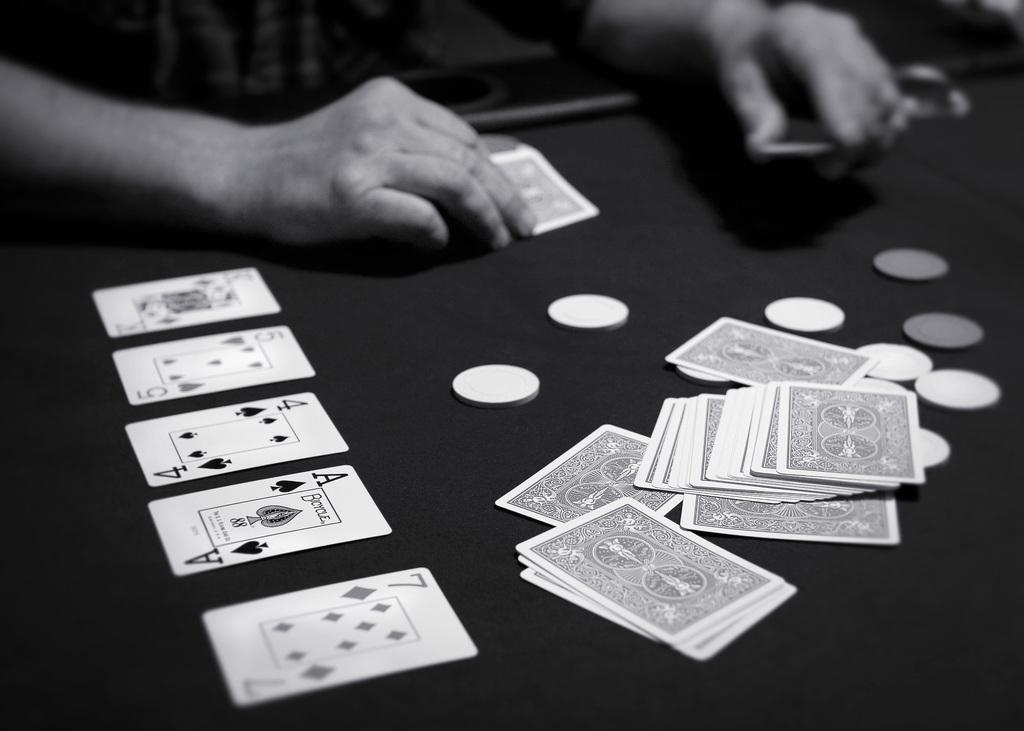
Tilt is an emotional or mental alteration that worsens the quality of decisions. It can appear after a bad beat, but it also arises from fatigue, haste, excessive confidence, fear of losing or the desire to recover the loss immediately.
The problem is not feeling frustration. This is part of a game with incomplete information and variance. The problem begins when emotion changes the process: you open too many tables, increase the buy-in without planning, call out of curiosity, force bluffs or continue playing without attention.
This guide does not promise to eliminate emotions. The goal is to create observable signs, limits and a recovery routine that protects decisions and bankroll.
Cover image: Todd Klassy on Wikimedia Commons, CC BY 2.0 license.
Tilt is not just anger
Some common forms are easy to confuse with "playing style":
- injustice tilt: feeling that the deck "should" compensate for bad results;
- revenge tilt: focus on winning chips from a specific opponent;
- recovery tilt: increase volume or stakes to end the session at zero;
- fear tilt: avoid profitable spots out of fear of losing;
- confidence tilt: assuming that every reading is correct after a good run;
- fatigue tilt: automatic decisions due to sleep, hunger or excessive screens;
- distraction tilt: playing while following messages, videos or too many other tabs.
Two players can feel the same frustration and exhibit opposite behaviors. One becomes aggressive; the other starts folding too much. Therefore, the protocol needs to observe actions, not just emotions.
A bad result does not prove a bad decision
You can bet all the chips with 80% equity and lose. You can also bet without odds, hit an unlikely out and win. The result of a hand alone does not tell you if the decision had a positive expected value.
To separate the result process, register before watching the showdown:
- position and effective stacks;
- previous actions and sizings;
- estimated range of the opponent;
- pot odds and required equity;
- considered alternatives;
- reason for the decision.
Then compare with the replay, the available data and, when necessary, a study tool. How to read a hand history helps to reconstruct the hand without relying on emotional memory.
Warning signs during the session
Choose concrete signs that can be perceived quickly. Examples:
- click before finishing the counting;
- stop writing down difficult hands;
- open a table beyond the planned limit;
- check the cash register after each pot;
- say "I need to recover";
- increase sizings to punish someone;
- ignore position, effective stack or ICM;
- repeat marginal calls without explaining the range;
- feel difficulty remembering the action of the previous hand.
A simple scale from zero to ten can help. Zero means normal attention; ten means inability to follow the plan. Set before the session the number that triggers a pause. Do not negotiate this limit in the heat of the moment.
Five-minute break protocol
When you reach the limit, the goal is not to "be happy". It is to interrupt the automatic reaction.
1. Stop opening new tables
Finish hands in progress without increasing the volume. In tournaments, it is not possible to abandon an entry without cost, so reduce stimuli and focus on the remaining tables.
2. Stay away from the screen
Take a few minutes for water, breathing and movement. Do not open results, poker groups or bad beat replays at that moment.
3. Name the trigger
Write an objective sentence: "I lost two favorite all-ins and started calling faster". Avoid narratives like "it always happens to me".
4. Read the return criterion again
Only come back if you can explain the plan for the next decision. If there is still urgency to recover, end it.
5. Record the hand, do not try to solve it on the spot
Mark the spot for the later review. The replay should be a learning tool, not an emotional extension of the session.
Stop-loss does not replace bank management
Stop-loss is an operational limit to close the session after a certain loss or mental deterioration. It can protect the process, but it does not turn an inadequate account into a safe account.
Management needs to consider format, average buy-in, variance, volume and financial condition. See Banking management in online poker to separate game money, personal reserve and stake limits.
Avoid setting the stop-loss only in cash if that encourages fear of playing good spots. Combine three types of limit:
| Limit |
Example |
Function |
| Time |
90 minutes without break |
Control fatigue |
| Behavior |
Two automatic click signals |
Protect decisions |
| Financial |
Defined range in the banking plan |
Avoid impulsive escalation |
In tournaments, financial loss is defined at the time of registration. The focus during the game should be execution; the main control occurs before, in the selection of the grid.
Routine before the session
A short preparation reduces improvised decisions:
- confirm duration and maximum number of tables;
- choose stakes and tournaments before starting;
- define pause criteria;
- remove notifications;
- review a specific concept;
- record energy and concentration from zero to ten;
- accept that the session may end negatively even with good decisions.
The weekly study routine helps distribute game, review and rest instead of trying to correct everything during the session.
Bias-free post-session review
Don't start with the biggest losses. Start with the marked decisions. Big pots catch attention, but repeated leaks in small pots can cost more in the long run.
Classify each hand:
- technical doubt;
- attention error;
- decision influenced by emotion;
- standard spot executed correctly;
- bad result with correct process.
In the GTO Vyve, use history, replay and notes to group patterns. Compare similar hands and look for frequency. An isolated decision may be an exception; twenty occurrences form better evidence.
The analyzer offers heuristics and organization in clear language. It is not an exact solver for all formats and does not guarantee profit.
How to build a tilt diary
A useful diary needs to be short enough to be kept. Use five fields:
- trigger: what occurred;
- sign: what changed in the body or behavior;
- affected decision: which action left the plan;
- response: pause, closing or adjustment;
- prevention: what to change in the next session.
Example:
Trigger: I lost a big pot near the bubble. Signal: I opened the lobby and looked for another more expensive tournament. Response: I did not register, closed the lobby and marked my hand. Prevention: remove late registrations outside the planned grid.
The diary should not become punishment. Its value is in revealing recurring triggers and working responses.
Tilt and excessive study
There is also a rush outside the desks. After a bad session, studying for hours without an objective can produce more confusion. Choose a sample and a question.
Instead of "I'm going to review everything", use:
- "I will review ten river calls above 50% of the pot";
- "I will compare cutoff opens between 20 and 30 BB";
- "I'm going to check all-ins near the bubble".
The study ends when the question was answered and a practical rule was recorded.
When to seek help
If poker is causing loss of control, debt, hiding expenses, harm to relationships or persistent suffering, stop playing and seek professional support and responsible gambling services. Self-exclusion tools and platform limits should be used when necessary.
No performance protocol can replace care for health and finances.
FAQ about tilt in poker
Is every player who gets angry in tilt?
No. Emotion is a sign; tilt is the deterioration of the decision-making process. Observe actions, speed and deviations from the plan.
Should I stop after any bad beat?
Not automatically. Stop when your signals and limits indicate loss of quality. The criterion must be defined before the session.
Does reviewing the hand immediately help?
It is generally better to just mark it and review it later when you have regained your attention. Urgency can contaminate the analysis.
Does Stop-loss guarantee that I will not have a loss?
No. Poker involves variance and risk. Stop-loss limits operational exposure; it does not remove losses nor replace bankroll management.
How can the GTO Vyve help?
The app organizes hand histories, replay, history and notes to compare process and result. Use it as study support, not as a promise of gain.
Conclusion
Controlling tilt means recognizing signs early, stopping the autopilot and going back to the process. Set limits before the session, make difficult decisions and review samples instead of chasing results. The goal is not to play without emotion; it is to prevent emotion from choosing for you.
👉 Review your decisions in the GTO Vyve without judging only the result. +18 | Poker involves risk and variance. Play responsibly.