Bluff catcher is a hand that wins the opponent's bluffs, but loses to almost all the value range it bets. On the river, you do not call because it "looks strong"; you call when the estimated bluff frequency, the offered price and the blockers make the call justifiable.
Top pair can be bluff catcher on one board and clear value on another. Even a straight can be only a bluff-catcher when flushes and full houses dominate the value area. The hand's role depends on the betting range, not the absolute name of your hand.
The most common mistake is calling out of curiosity or folding out of fear without counting combinations. A simple process reduces emotional decisions.
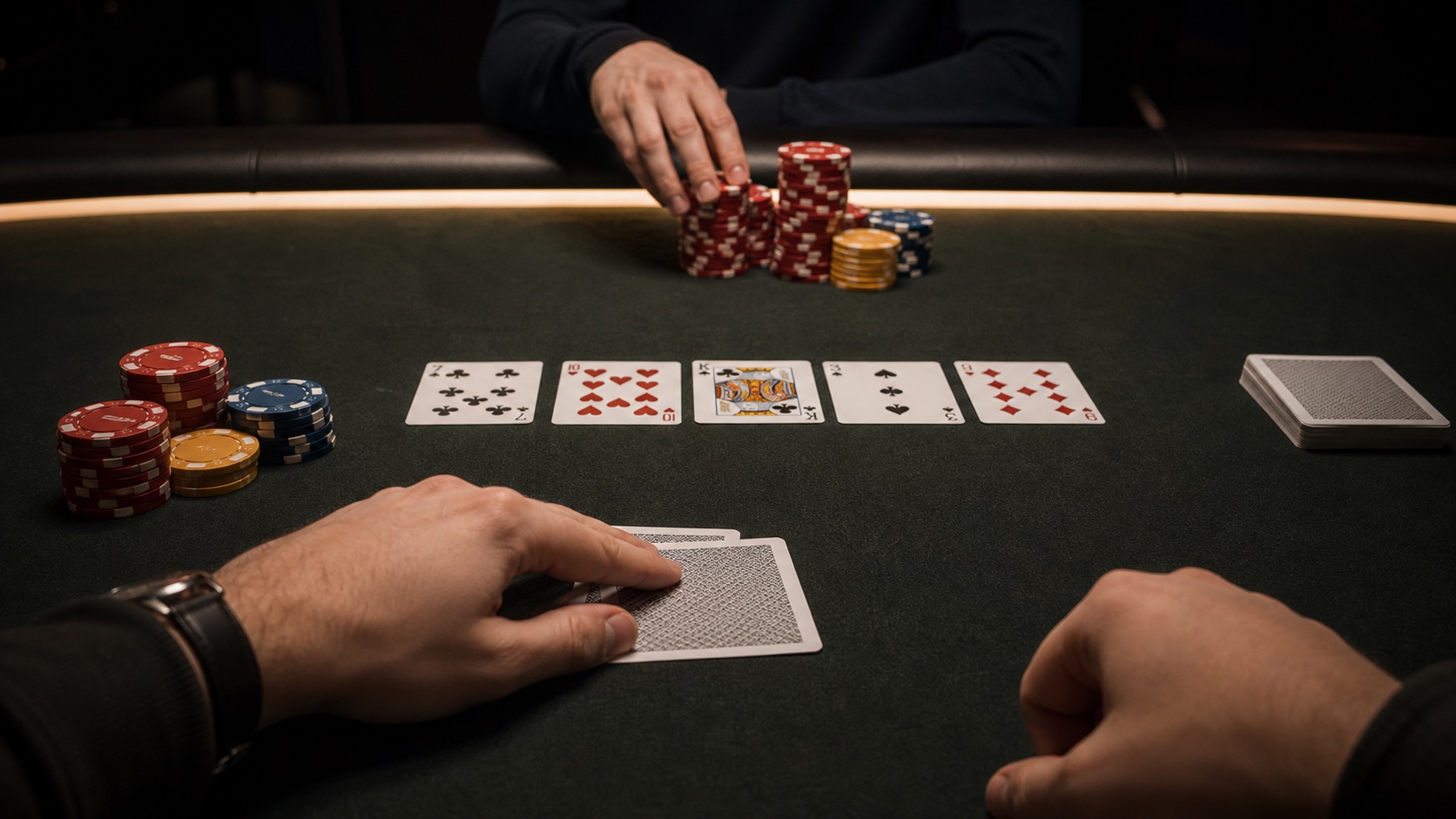
Original cover image created for the GTO Vyve Poker.
First: calculate the pot odds
Pot odds show the minimum equity for the call to tie. If the pot is 100 and the opponent bets 50, you call 50 to contest a final pot of 200. You need to win 25% of the times.
Useful references:
| Bet on river |
Approximate minimum equity |
| 33% of the pot |
20% |
| 50% of the pot |
25% |
| 75% of the pot |
30% |
| 100% of the pot |
33.3% |
| 150% of the pot |
37.5% |
Read pot odds in poker to review the formula. In the river there is no future equity: you are comparing your hand directly with value and bluffs.
If you need to win 25%, the rival range doesn't need to have half as many bluffs. About a quarter of the range that bets would already be enough for the call to tie, before rake, ICM and estimation errors.
Bluff catcher is not the same as average hand
A medium hand can still win part of the value bets. In this case, it has more equity than a pure bluff catcher. On the other hand, a visually strong hand can lose to all-in value.
Example: board A♣ K♣ 8♦ 4♣ 2♣. You have A♦ Q♠. Top pair with good kicker seems strong, but against a big bet many values are flushes. Your ace without spades does not block these flushes. The hand can only win bluffs and become fragile bluff catcher.
Now imagine a river that does not complete draws and the opponent bets on worse pairs for a small stake. Your top pair wins value, so the decision changes.
Before calculating, ask yourself: what valuable hands do I really win if I bet on?
Count value combinations
Reconstruct the line from the pre-flop. Do not put in the river's range hands that would have chosen other actions.
List:
- nuts and seconds nuts;
- sets, two pairs, consistent straights or flushes;
- fine value that uses this sizing;
- combinations removed by the cards on the table and by your hand;
- strong hands that would probably increase before.
If the opponent makes an overbet, the value is usually more polarized. If you bet 25%, you can include a thin value. The size changes the boundary between value and bluff.
Avoid phrases like "he represents little" without listing the combinations. Few types of hand can contain many combinations; several lost draws can be blocked by your own holding.
Then count the natural bluffs
River bluffs usually come from draws they lost or hands turned into bluffs. Check if these combinations got there.
Useful questions:
- which flush draws lost;
- which straight draws lost;
- which hands with showdown value would need to bluff;
- which draws betted flop and turn with this size;
- which combinations would give up sooner;
- if the player demonstrates the ability to transform pairs into bluffs.
Not every lost draw turns into a bet. Some get checked. At limits where the population bluffs little at large sizings, assuming that all draws are shooting can produce expensive calls.
At the same time, do not use unproven stereotypes. A three-handed reading is not a reliable trend.
Blockers: the detail that orders the calls
Two bluff catchers with the same hand can have different quality.
Blocking value is good
If your hand reduces strong combinations you bet on, there are proportionally more bluffs left. On a board with possible flush, having a card of the relevant suit can block part of the flushes, depending on your own hand and the community cards.
Blocking lies is bad
If you hold the card that would appear in the lost draws, you remove bluffs from the rival range. Your call gets worse, even if the absolute value of the hand does not change.
Unblockers also matter
A good bluff catcher makes natural bluffs available. It is common to prefer a combination that does not block the missed flush draw or the missed straight draw.
Use blockers after building the ranges. Saying "I have a blocker" without specifying what value it removes and which bluff it preserves is just a vague justification.
The line of action is worth more than an isolated tell
Analyze the complete story:
- pre-flop position and ranges;
- sizing on the flop;
- second barrel in the turn;
- river's letter;
- speed and size of the bet as secondary information;
- pot/stack ratio;
- previous showdowns with a similar line.
A big bet on river can represent strong value when the board has changed in favor of the aggressor. In another runout, the same bet can attack a capped range. See river in poker to organize value, bluff and showdown in each runout.
Time tells can help in specific environments, but connection, multitable and routine cancel out most of the online signal. Don't trade math and ranges for a timer.
Example of step-by-step decision
80 blinds pot on the river. The opponent bets 60. You need to call 60 to contest 200, so the minimum equity is 30%.
After rebuilding the line, you estimate eight value combinations and four natural bluffs that you can bet on. Against this model, there are 4 bluffs in 12 bets, or 33.3%. The call would be slightly above the break-even point.
But your hand blocks two of the four bluffs and no value. The effective range becomes eight values and two bluffs: only 20% bluffs. The fold becomes better.
This example shows why "my hand is at the top of the range" does not end the analysis. The top may contain combinations with better blockers for calling.
Estimates do not need to be perfect to improve the decision. Even an approximate and honest count is better than calling just to see.
Minimum defense frequency: use with care
MDF (minimum defense frequency) estimates how much of the range should continue to prevent automatic bluffs from making money. Against a 50% pot bet, the theoretical defense reference is 66.7%; against the pot, 50%; against 150%, 40%.
This does not mean calling with any hand until you reach the number. Your defense includes calls and raises and depends on the composition of the range. In environments with clear underbluff, exploiting with additional folds may be correct.
MDF is a reference point, not an order. First determine if the opponent has enough bluffs and what combinations yours are the best calls.
Population trends and sample
Data can help when the definition is consistent and the sample is sufficient.
Register by size and line:
- frequency of betting on river;
- showdown after big bet;
- lost draws transformed into bluff;
- thin value in small sizes;
- difference between position and out of position.
Don't combine a 25% bet and a 150% overbet in the same category. Also don't conclude that someone "never lies" after two value showdowns.
In pools where river bluffing is common, exploitative folds can save chips. Against aggressive players who find natural bluffs, overfold opens up space for pressure. The decision should be guided by evidence, not by labels.
MTT, ICM and elimination risk
Pot odds measure chips, but tournaments may require monetary analysis. In the bubble and at final tables, losing the call can cost more expected payout than the equivalent gain adds.
Consider:
- if the call puts your tournament at risk;
- who covers who;
- stacks of players out of reach;
- award jumps;
- bounty available in PKO;
- future alternatives if you fold.
This does not turn every bluff catcher into a fold. It means that chip EV and monetary value can diverge. Review ICM explained to separate the two contexts.
Common errors in river
Call to get information
Information has value, but it rarely justifies a big negative call. Watch free showdowns and record patterns without buying curiosity at any price.
Only look at absolute strength
"I have top pair" does not answer what values they bet and what bluffs exist.
Inventing lies
If the natural draws did not arrive through the line, do not add combinations just to justify the call.
Ignore the blocker itself
Holding the lost draw card can remove exactly the bluffs you expect to win.
Judge by the showdown
Making the right call and finding value does not make the decision bad. Folding and then seeing a bluff shown does not prove error either. Compare range, price and frequency.
Checklist before the call
- what minimum equity the sizing requires;
- your hand wins some amount;
- what values arrive through the line;
- which natural bluffs arrive;
- your hand blocks value or bluff;
- the opponent has a reliable sample;
- the stack and the ICM change the cost;
- which combos of your range are better calls.
If the time is short, use three questions: what is the price, what bluffs are there and what does my hand block?
FAQ
Bluff catcher needs to be top pair?
No. Any hand that wins bluffs and loses to the value can fulfill this role. It can be a pair, two pairs, straight or even flush in very strong boards.
Pot odds alone decide the call?
They define the minimum equity. You still need to estimate value, bluffs, blockers, line and tournament effects.
Having the top of the range means calling?
Not automatically. The top should defend in theory, but some combinations block bluffs and are worse calls than others with similar strength.
How to know if the opponent lies little?
Use showdowns and sample separated by line and sizing. Avoid generalizing from a few hands.
Can I study bluff catch without a solver?
Yes. Reconstruct ranges, count combinations, calculate pot odds and compare blockers. Validated solutions refine frequencies, but the basic process already eliminates many calls out of curiosity.
The GTO Vyve helps mark river calls, rebuild action and compare sizing patterns. The tool organizes the study, but it does not promise profit nor replace a validated GTO solution for each spot.
+18. Poker involves risk and variance. Play responsibly and never chase losses.