In a common tournament, the prize increases as the placement goes up. In many satellites, several qualifiers receive exactly the same ticket. This difference changes the value of the chips near the bubble.
If ten players win an identical spot, finishing first or tenth can generate the same prize. Accumulating all the chips ceases to be the goal. The goal now becomes to survive with enough probability to win the seat.
This does not mean "folding everything". It means comparing stack, positions, number of spots and elimination risk before applying ranges of a normal MTT.
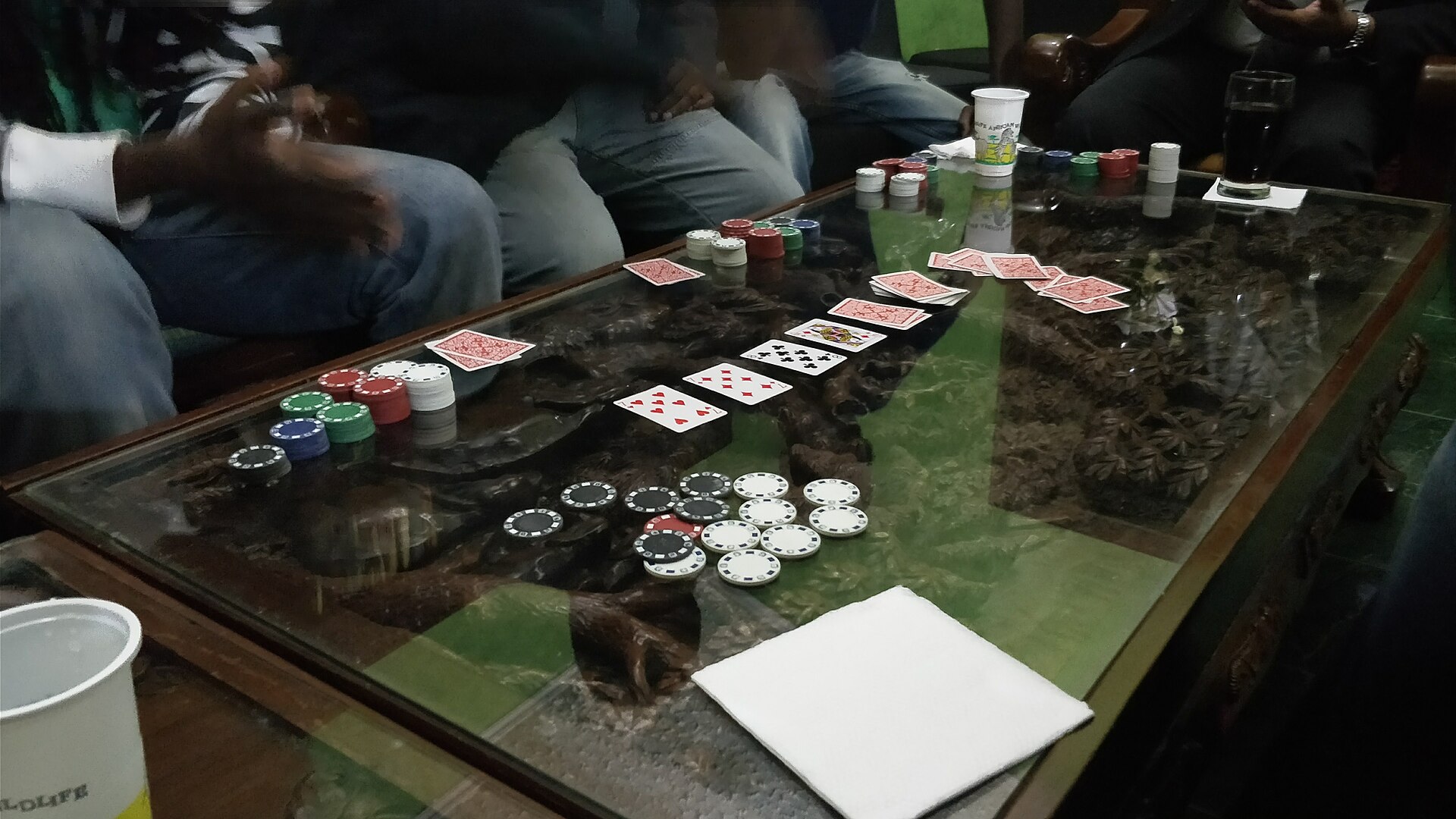
Cover image: Hilary Murugu on Wikimedia Commons, CC BY-SA 4.0 license.
Why do the coins change value?
In chip EV, a winning chip and a losing chip have an approximate linear value. In a satellite near the bubble, this relationship ceases to be linear.
Imagine six players for five tickets. A leading stack has 50 BB; four players have between 12 and 20 BB; the short has 1.5 BB. The leader does not need to face a marginal all-in against a medium stack. Winning more chips almost does not increase your chance of receiving a higher prize, because the ticket is fixed. Losing, however, can return real risk of elimination.
This unequal cost is explained by the ICM in poker: tournament chips do not directly equate to money or tickets.
Mandatory information before the decision
In the bubble of a satellite, look beyond your cards:
- how many players are left;
- how many vacancies are there;
- stacks of all, not just from your desk;
- blinds positions;
- speed of increase of blinds;
- players in all-in at other tables;
- hand-for-hand rules;
- ticket value and restrictions;
- possibility of reentry or alternative prize.
Without this information, an apparently "correct" range can be completely out of context.
The leading stack
The leader can pressure medium stacks because they risk a ticket when calling. However, they also need to avoid confrontations that bring relevance back to the risk itself.
Good opportunities include:
- open against stacks that cannot call without strong hands;
- attack blinds when shorts are close to falling;
- use sizings that preserve flexibility;
- reduce all-in calls that do not improve the chance of winning a seat.
The common mistake is to interpret leadership as permission to play any hand. Pressuring is different from folding an opponent without need.
The average stack
The average stack usually faces the greatest tension. It has too many chips to give up automatically and fewer chips to guarantee the seat.
Before putting it in a pot, ask yourself:
- is there a much shorter player?
- how many orbits my stack can support?
- who covers me?
- if I fold, will my chance of qualifying continue to be high?
- if I win, does the increased probability compensate for the risk?
Against an aggressive leader, hands that would be clear calls in chip EV can turn into folds. Against a short that threatens to overtake you, the action can be different.
The short stack
The short cannot wait indefinitely. When elimination by blinds approaches, you need to choose spots with fold equity or enough equity.
Prioritize:
- final positions when everyone folds;
- opponents capable of giving up;
- hands that maintain equity when paid;
- timing before losing fold equity;
- comparison with shorts from other tables.
Push/fold tables by position are a starting point, not a final answer. In satellite, ICM and stack distribution can leave the range much tighter or create urgency.
Example: fold with strong hand
There are six players left for five spots. You have 18 BB in the big blind. The leader, with 55 BB, puts all-in on the small blind. Another player has 1 BB and will face the big blind in the next hand.
In a common MTT, several strong hands would call. On the satellite, losing the all-in can eliminate you while the short is almost forced to risk it. Even visually strong hands may not justify the risk.
This does not produce a universal rule like "fold poker". The calculation depends on stacks, blinds and payouts. The lesson is that absolute hand strength is not enough.
Example: necessary aggression
There are eight left for six slots. You have 4 BB on the button; the blinds have 15 BB and 20 BB. The other shorts have 7 BB and 9 BB. All fold to you.
Waiting can reduce your stack to the point of losing fold equity before the others. A wider shove may be necessary, especially if the blinds face a strong call cost.
The opposite error to excessive action is to be too passive and be eliminated without contesting cards.
Open shove, raise small or fold
The best size depends on stack and opponent's response.
Open shove
Avoids post-flop decisions and maximizes fold equity. It may be suitable with short stacks, but it risks the entire tournament.
Raise small
Presses while preserving chips against 3-bet. Works best when the stack allows folding and opponents cannot exploit with excessive re-shoves.
Fold
It can have enormous value when other players are about to be eliminated. Fold is not a weakness if it preserves a high probability of ticket.
Each option needs to be evaluated with the entire tournament, not just with the hand.
Call is more expensive than shove
In many bubble spots, the shover has fold equity; the caller does not. This creates asymmetry:
- the shove can win without showdown;
- the call needs to beat the all-in;
- losing the call can destroy an almost-guaranteed seat.
That's why call ranges usually stay much tighter than shove ranges. Copying an all-in table to decide calls is a serious leak.
Hand-for-hand and watch
In hand-for-hand, the tables finish the hands in a coordinated rhythm. Time decisions can influence who faces blinds first, but room rules must be respected. Do not use deliberate disconnect, collusion or any action that violates platform terms.
Observe official results from other tables and keep the game within the rules. Strategy does not justify unsportsmanlike behavior.
Satellites with different tickets
Not all satellites have a flat payout. Some offer:
- tickets of different values;
- money for excess positions;
- more vacancies and balance;
- later phases instead of final prize;
- non-transferrable ticket or with a specific date.
Read the lobby. If first place receives an additional prize, there is an incentive to accumulate chips. If everyone receives the same ticket, survival dominates more strongly.
Common mistakes in the bubble
- Apply normal MTT range without considering equal tickets.
- Call an all-in because the hand "is too good to fold".
- Ignore stacks from other tables.
- Confuse leadership with the obligation to eliminate players.
- Wait until you lose all fold equity.
- Only use your own BB number.
- Not knowing how many vacancies are left.
- Register without checking the use, date or transfer of the seat.
- Judge the decision only by the showdown.
How to review satellite hands
Save the hand history and note the tournament status. The poker-site export does not always record stacks from other tables or number of seats, so supplement during the session when possible.
In the GTO Vyve replay, record:
- remaining players and vacancies;
- own stack in BB;
- stacks that cover you;
- known smaller stacks;
- next passage of the blinds;
- fold alternative;
- consequence of winning and losing.
Also read How to qualify for satellite BSOP for buy-in planning and selection of classifiers.
The GTO Vyve helps organize history, replay and notes in clear language. For exact ICM decisions, use tools appropriate for the payout and confirm the tournament data. No analysis guarantees qualification.
Decision checklist
Before clicking, answer:
- Is my stack close to guaranteeing the ticket?
- Is there anyone about to fall?
- Who covers me?
- Do I have fold equity?
- Does my call need to be much tighter than my shove?
- Is the payout really the same?
- Does this action increase the chance of a ticket or just my chips?
If an essential piece of information is missing, reduce the confidence in the decision.
FAQ about satellite bubble
Should I fold aces in the bubble?
Extreme cases may exist, but do not make this a rule. The decision depends on stacks, spots, blinds and payout. Calculate the specific risk.
Should the leader put all-in all his chips?
No. He can press, but unnecessary confrontations can reopen the risk of elimination and double opponents.
Push/fold table is it suitable for satellite?
It serves as a reference for chip EV. Close to the bubble, ICM and equal tickets can change a lot of shoves and mainly calls.
Why does the call get so tight?
Because it does not have fold equity and can trade a likely seat for elimination. The cost of losing outweighs the benefit of accumulating chips.
Can I analyze satellites in the GTO Vyve?
You can import compatible hands, review actions and log context. Data missing from the payout and the other tables needs to be added to the analysis.
Conclusion
The satellite bubble rewards probability of qualifying, not chip leadership. Compare spots, stacks and elimination risk; separate shove and call ranges; preserve fold equity when you are short. The best decision may seem conservative or aggressive, but it needs to serve the seat.
👉 Review bubble hands and stacks on GTO Vyve. +18 | Poker involves risk and variance. Play responsibly.